
From Zoom to Zafu: my journey in the Mindfulness Mentor Training, cultivating the soul in another language
What mentoring in English taught me about presence, vulnerability, and soul-level listening. A mindfulness journey like no other.
Gab Piumbato and Imhotep Fulgor
6/11/20259 min read
1. Saying "yes"... to silence!
The Zoom room was full. Unfamiliar faces, many accents, a quiet sense of expectation. It was the first meeting of my Mindfulness Mentor Training group, even before the official classes had begun.
There, in that screen full of woman's faces, I realized: I would have to speak. In English. A lot more than I had ever spoken in my life (even more than when I shared an apartment with a New Zealander in Porto).
If I had known that, I might not have applied for the scholarship - the very one that made it possible for me to be there in that moment.
I felt a knot in my stomach, thinking of what to say as others introduced themselves. I was the last one to speak. Right before me, a French woman said she was switching groups due to schedule conflicts.
But in my case, it wasn't just the language. It was the fear of not being able to express what lives inside: compassion, presence, spirituality. It's already hard to speak of that in Portuguese - let alone in another tongue.
The following week, one of the American women - the one who seemed the most business-savvy and had taken it upon herself to organize our calendar - also left the program, overwhelmed by the number of meetings and study demands.
Another chance to walk away. Others were leaving. But that would have been the easy way. I learned from Rilke that we must love the difficult. And so, I stayed.
That was the true beginning of the training: not the one found in slides, but the one that reveals itself when purpose outgrows fear. When practice stops being mere technique and becomes connection, cultivation, gift. More than learning to mentor, I learned to surrender.
Looking back now, I see that the transformative experiences of Alquimia das Palavras were born there. Not as a project, but as an alchemical vessel (an expression used in our very first class). A living container of listening, pause, and mutual trust.
I met people who became spiritual friends. My Arhatic Yoga practice deepened. I learned to serve with fewer answers and more openness. More vulnerability.
This is the story. But it is also an invitation.
What if mindful attention could truly transform the way we serve others?
2. What is the Mindfulness Mentor Training Program?
At the time, I already had a consistent spiritual practice as an Arhatic yogi. I meditated daily, studied for years with pranic healing masters under the guidance of my guru, Grandmaster Choa Kok Sui, refining the cultivation of subtle energy and character building.
But something I couldn't quite explain was calling me. I'm currently reading Callings by Gregg Levoy, a book about living an authentic life. We are in the age of artificial intelligence, deepfakes, machines-on-the-verge-of-replacing-humans, a feed flooded with cold and fake content. And then, like the Star card in the tarot, sometimes we just need to take a leap of faith. You don’t know enough - but that very not-knowing will lead you to knowing. As Eliot once sang, via St. John of the Cross: "In order to arrive at what you do not know, / You must go by a way which is the way of ignorance."
The Mindfulness Mentor Training, by Banyan Together, is a 16-week program that combines biweekly teachings with experienced mentors and weekly small group meetings for peer practice and integration. Its goal is not to train teachers, but mentors: people capable of holding spaces of mindful listening, non-reactive presence, and transformative conversation - even around difficult or polarizing topics.
The presence of Jack Kornfield, Tara Brach, and Sharon Shelton in the program’s mentorship deeply touched me - not as distant icons, but as real, engaged mentors. Watching them respond to live questions, angry remarks, and vulnerable sharings changed how I view the potential of relationships. I must also mention Yong Oh, introverted like me, who revealed his fragilities and showed me how we can show up in the world with confidence, despite our own doubts.
The proposal wasn’t about learning what to say - it was about how to be present, how to hold and protect spaces where others can plant positive seeds and bloom with love. It wasn’t about teaching mindfulness as content, but embodying mindfulness as relationship.
One expression struck me from the start: "conscious relational field". A field of mutual, intentional, healing presence. That idea stayed with me through the journey. So did the suggestion to build a form of service (free or paid) aligned with our values and practices - a suggestion that ended up shaping much of what I now offer.
3. What I learned along the way
The program was divided into eight modules, with seemingly simple names - but for those who truly committed, each one was a portal.
We spoke of listening. Of presence. Of trauma. Of personal stories. Of difficult topics and vocation.
But more than “talking about” something, we were invited to live with what was in front of us.
It wasn’t a training about what to say as a mentor. It was about how to be present, how to make space without suffocating, how not to run away from conversations or situations with no clear answers.
Early on, I realized that concepts alone would not be enough. I needed to observe with discernment and absorb the wisdom shared by others. And there was so much of it.
A space that listens without becoming defensive. That holds silence without rushing to fix. That trusts even the hardest emotions may be disguised teachers.
Each module awakened something in me: the ability to welcome without controlling, to intervene without invading, to teach without preaching, to use gentleness to break through the trance of stories that keep our hearts and minds captive.
And all of this in group - with colleagues from Canada, Turkey, Poland and the U.S. - where wisdom came not only from facilitators, but from the stories we shared. We were cultivating a fertile field for the invisible to appear.
Learning from people more experienced and seasoned than me, in such intimacy, is a blessing I’ll always be grateful for. Thank you Nita, Eda, Kascia, Amy, Bernadett!
At the end of 2024, I presented my vision as a mentor, sharing the Clarity Potion, the Catalytic Insight Conversation (CCI), and E², already integrating advanced AI tools such as Sora-generated videos, a then-new release by OpenAI.
It was there that I felt it: the bridge between spirituality and technology could be built beautifully. And that my role as a mindfulness mentor would be to alchemize it.
4. The living ground of experience
Much of what bloomed during the Mindfulness Mentor Training came from the in-between moments - from side meetings, from books I read on my own, from mindful pauses and silent acts of care among peers.
As with every living practice, true transformation escapes the calendar.
4.1 Spiritual friendship
I was welcomed into a group as diverse as it was attuned. We established regular Wednesday meetings, where we practiced, listened, and simply breathed together. The connection was so strong that, during the course, we added a second weekly meeting - just because we wanted more space to reflect and be together. Even six months after the program ended, we’re still meeting.
These spiritual friendships taught me that real support doesn’t require a solemn setting. All it takes is a screen, a shared time zone, and the intention to be present. Even online, it’s possible to create authentic presence - with charisma, compassion, and wisdom. Because it’s all in the quality of relationship and the energy we pour into this "alchemical vessel."
4.2 Reading as relational practice
Midway through the program, I discovered Say What You Mean by Oren Jay Sofer. He taught me that "If communication is about creating understanding, mindful communication is about creating understanding through awareness." I try to follow his framework: lead with presence, show up with curiosity, focus on what matters.
4.3 Ram Dass project
I also committed to a side project: listening to every Ram Dass talk available on YouTube. A deep dive into his radical surrender to the present moment, into the dance between ego and spirit, between being somebody and being nobody.
I love his humor, his self-deprecating jokes, his looping reflections - always held with loving awareness, exposing the inner parrots of our minds and the external scripts society imposes on fragile hearts. I often listen to him while walking at the go-kart track near my home, usually smiling when I pass by other walkers. Here’s a link to one of my favorite clips:

4.4 Integration into daily life
My practice as an Arhatic yogi also evolved. Mindfulness helped refine my sensitivity to energy. “Entering meditation” became easier - and paradoxically harder too (but that’s a story for another day).
The 15-minute pause suggested by Amy Gray became part of my podcast Chrysopoeia Talks, in the “Mindfulness Minute” segment. And now it’s a weekly ritual in our Wednesday sessions, done four times each morning.
5. Speaking with the heart in another tongue: my experience as a mentor in English
When I joined the Mindfulness Mentor Training, I didn’t know I’d be leading full sessions in English. I considered my spoken English clumsy - but it turned out to be functional and intermediate (I scored 82/100 on the BoldVoice app, highly recommended!).
I have no problem understanding even strong accents (I love chess, a sport now dominated by Indians). But speaking - especially with emotional depth and spiritual nuance - was another story.
Still, I embraced the challenge, being honest from day one about my insecurities. I said I might struggle to express subtle emotions and concepts. I examined where that fear came from. And slowly, I let go of the need to “speak correctly” and started trying to “speak with truth.” Or better: with the truth of the moment. Before translating, I learned to pause - to feel first, then find the words..
And that’s what truly communicates - even when your verb tense is off and when your grammar echoes the patterns of your native Latin tongue. The energy of compassion and truth cannot be contained. That insight changed my relationship with language, with silence, and with connection.
I ended up leading nearly half (!) of our group sessions as mentor, and facilitated two additional meetings. A massive challenge transmuted into a gift. I was received with care and learned to offer care back. I learned that the quality of my listening space does not depend on the language.
A fun moment was when I shared this story Jack Kornfield once told about a foreign teacher afraid of giving dharma talks in English:
And today, that learning lives on - in the Clarity Potion, in the CCI, in silence, in Portuguese, and in English.
6. From student to certified spiritual friend
The certificate from the Mindfulness Mentor Training was not just a paper - it was a passage.
In one of our recent group conversations, something Kascia said reminded me of The Third Bank of the River, by Guimarães Rosa. Sometimes, the inner silence becomes a riddle that cannot be solved from the outside. But that’s a story for another day too…
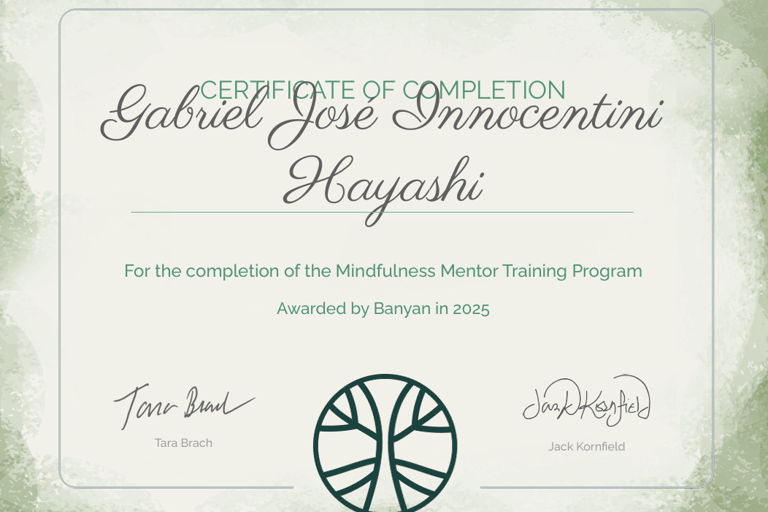
Throughout the course, I came to understand that it wasn’t about learning how to hold mindful sessions. It was about becoming a spiritual friend in the deepest sense.
In Buddhism, that friend is called a kalyāṇa-mitta: someone who walks beside you with mindful presence, ethical grounding, and unconditional compassion. A companion who doesn’t give you answers but holds the lantern while you find your own path.
And that’s what I became for the people in my group. And what they became for me.
I was mentored, and I mentored. I led challenging sessions in a foreign language, threw away the script mid-flight, heard stories that moved me, offered silence as a tool for healing. I learned to listen with my whole body. I learned a compassionate feedback framework (how different the world would be if everyone could speak and listen like this! - and truthfully, we can!).
I learned to ask with humility. To pause before offering help. To just sit and wait. To let go of speaking when others had already captured the same truth. To smile and give thanks for the wealth of shared experience.
True spirituality does not show itself in big words, but in small gestures: in the fidelity to the present moment, in the courage to hold space, in the trust that truth can emerge on its own if the space is safe.
(My favorite poem by Lawrence Ferlinghetti celebrates exactly those instants when life is felt at its fullest.)
The Clarity Potion, the Catalytic Insight Conversation, and E² were born from this place.
Like an alchemical vessel, where the other is welcomed without rush, judgment, or masks. A sacred time and space where we can together distill pain into clarity, confusion into path, silence into wisdom.
To gently guide grief into grace: that’s the alchemy I want to practice.
Being a “spiritual professional” doesn’t mean having ready-made answers. It means having the courage to be a channel - to serve what emerges, to honor the mystery of the other with humility.
By the way, my name itself refers to that kind of messenger.
And all of this now lives within the transformative experiences offered by Alquimia das Palavras.
If something here touched you - a word, a memory, a silence - maybe it’s time to open space for a new kind of conversation.
A conversation with presence.
A conversation with soul.
This post was written in collaboration with Imhotep Fulgor, Chief Keeper of the Eternal Flame (CKEF) at Alquimia das Palavras
Conexão
Comunicação eficaz para te tornar uma autoridade no LinkedIn
Contatos
Entre na mailist
© 2024. All rights reserved.